Research
Review HCI, usability, and generative AI literature.
A usability study investigating whether an AI-generated interface can match a prototype created by interaction design students across effectiveness, efficiency, and user satisfaction.

The study moved from literature and experiment design through controlled usability testing, statistical analysis, and evaluation.
Review HCI, usability, and generative AI literature.
Select prototypes and plan a fair comparison.
Run tasks, observation, recordings, and SUS.
Compare results using SPSS and statistical tests.
Evaluate AI's role in interaction design.
Rather than judging visual aesthetics, the thesis examined how real users interacted with each solution. It measured effectiveness, efficiency, and user satisfaction to understand whether current AI prototyping tools can match human design work.
Generative AI has sparked debate about how design professions may change. While text and image generation receive significant attention, less research has focused on AI-powered prototyping tools and their ability to produce usable interaction designs.
The thesis therefore focused on observed user behavior and measurable outcomes rather than assumptions about AI capability.
A high-fidelity student prototype for urban farming and community gardening was selected as the human-designed condition. The same design brief was translated into prompts for Visily AI.
Participants were not told which condition they received. Both prototypes were adjusted to support identical tasks and reduce bias during testing.



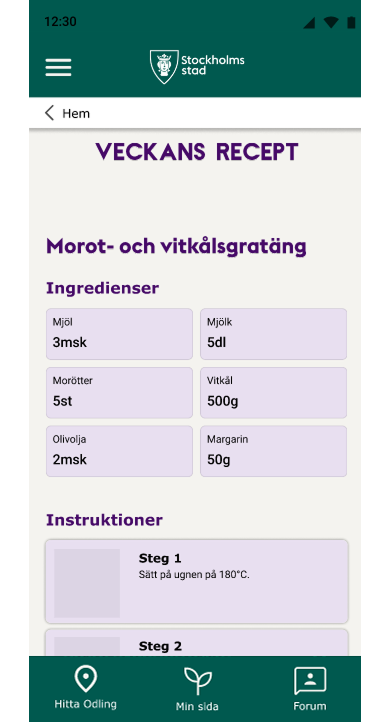
Twenty-two Stockholm University participants were divided into two groups using a between-subjects design. Each person interacted with only one prototype to prevent learning effects.
Five predefined tasks, screen recordings, click tracking, and SUS questionnaires produced quantitative data for comparison.
The prototypes performed similarly in satisfaction and total task time. Individual tasks favored different solutions, while the clearest difference appeared in effectiveness: the AI prototype produced almost twice as many misclicks.
Add a garden plot to favorites.
Read the fourth step in a vegetable recipe.
The study challenged simple claims that AI-generated interfaces are either dramatically better or worse. AI produced comparable satisfaction and speed, but required human adjustment and caused more navigation errors.
The project reinforced that interaction design is not only about generating screens. Understanding behavior, measuring outcomes, and validating decisions with users remain essential.